EoL in December 2024
The EoL Achievements
Internal Audit for Fair-Trade farms
In preparation for the upcoming international Fair-Trade audit in January, we conducted a comprehensive internal audit in December to ensure full compliance with Fair-Trade standards across our farms.
Training sessions on Fair-Trade standards for all participating farms.
Workshops on women’s and children’s rights to promote fair and ethical working conditions.
Distribution of the updated Fair-Trade Hazardous Substances List along with the approved pesticides list provided by Fair-Trade.
The internal audit visits
17 December 2024: El-Hager and Abo-Khateb farms – El-Beheira Governorate
18 December 2024: El-Feky, Ali Sayed Ali, Mahmoud Rabea, and Mashour farms – Fayoum Governorate
24 December 2024: El-Gezira and Somosta farms – Giza and Beni-Suef Governorates
25 December 2024: Moftah, El-Rouby, and Gamal farms – Minya Governorate
EoL Research and Development
A. Biodiversity Assessment
EoL has started to assess biodiversity performance at its farm by using Cool Farm Tool (CFT) Biodiversity assessment metric. The first pilot study was conducted on 15th of December in Wahaat. This metric evaluates what kinds of biodiversity maintenance and improvement practices are regularly done at a farm. The survey, which consists of 4 sections and 29 questions in total to cover biodiversity practices at a farm comprehensively, was filled by individual 9 farmers under the support of the field engineer in Wahaat.
As a result of this survey, 9 reports for each individual farmer were gained as one of them is shown below for instance. The assessment consists of 4 categories:
- Farmed products: to see how many species of crops and livestock exist at the farm.
- Farming practices: to see how farmers do agriculture such as fertilizers usage etc.
- Small habitats: to see how much space there is at the farm for non-cultivation activities that allow other species to live in.
- Large habitats: to see how farmers take care of the space outside their farm.
challenging for farmers to specify how much natural habitat they have such as shrubs, water channels etc, which needs to be adjusted in the next pilot study.
The engineer and farmers during the research were very welcoming and heartwarming. The farm tour was provided by them before and after the survey at one of the EBDA biodynamic farms. Some additional questions were asked to farmers such as:
- Would you become a farmer again under EBDA, if you had another life? – YES.
- How did you decide to implement EBDA biodynamic practices? – IT WAS TOUGH IN THE BEGINNING.
The answers are not elaborated here in detail because these are not directly related to biodiversity research, but it was discovered that the EoL farmers are really proud of being an EoLfarmer.
- The farmers in Wahaat make biodiversity efforts to some extent, but their knowledge and awareness about biodiversity is limited.
- Observing that farmers were enthusiastically answering questions, they are very interested in working on biodiversity improvement at their farm.
- The above-mentioned points indicate that there is demand in educational materials regarding biodiversity at the farm.
- It was difficult for them to answer some of the questions in the survey, which needs to be adjusted according to feedback from farmers and engineers to scale up this research.
B. EoL Impacts on rural areas – collaboration with J-PAL
The collaborative research project with J-PAL, an international research institute based in The American University in Cairo, experienced progress. The J-PAL research team aims at evaluating impacts of Economy of Love Certification on Egyptian rural areas, and EBDA provides the J-PAL research team with their access to EBDA extension engineers and farmers.
Although the project has been at the research-design stage, the field visit was conducted on 12th of December in Damietta with the EBDA team and J-PAL research team so that the J-PAL team could become more familiar with the EoL mechanism in the field.
The J-PAL research team conducted interviews with engineers and farmers respectively to understand how engineers and farmers work to achieve their biodynamic transformation according to the Economy of Love Standard. In addition, the J-PAL team visited the EBDA office on 18th of December to design their research further. EoL was asked to choose any 20 villages that don’t have EoL farmers and create a scenario where an extension engineer reaches out to new farmers in a village, which is relevant to assess the impacts of EoL standard on rural villages. This request, however, would change engineers’ way of working. Therefore, this requires very precise documentation of how engineers should work from the J-PAL team side and effective communication between EoL administration team and field engineers.
The EoL Agronomists’ Training
Empowering agricultural engineers through specialized training in precision farming, sustainable pest management, soil fertility enhancement, and water-efficient irrigation techniques. These initiatives not only advance the professional development of engineers but also promote environmentally friendly practices, fostering sustainable agriculture that benefits both farmers and the environment. The EoL intensive training for the 50 new agronomists who joined the EoL recently had the chance of getting two weeks intensive training at SEKEM farm in the sharqia region.
EoL Farmers’ Growth December 2024
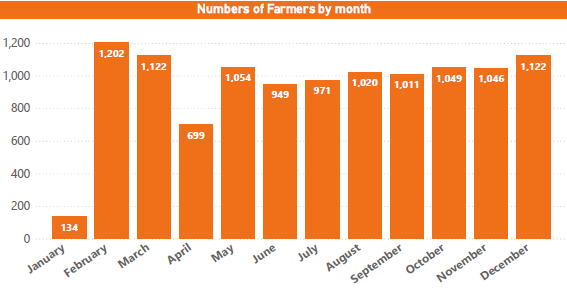
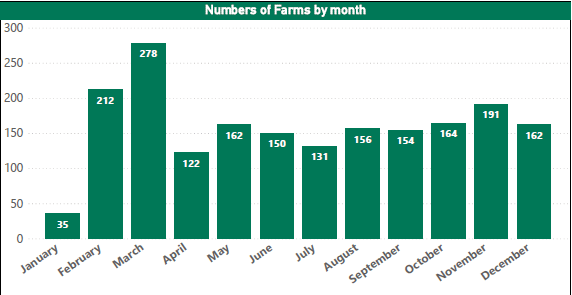
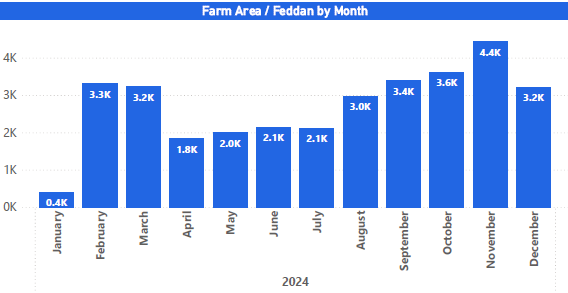
EoL extension engineers successfully registered 162 new farms in December that included 1,122 farmers with a total area of 3,200 acres.
Total farms: 3,250
Total area in acres: 62,141
Total farmers: 16,368